
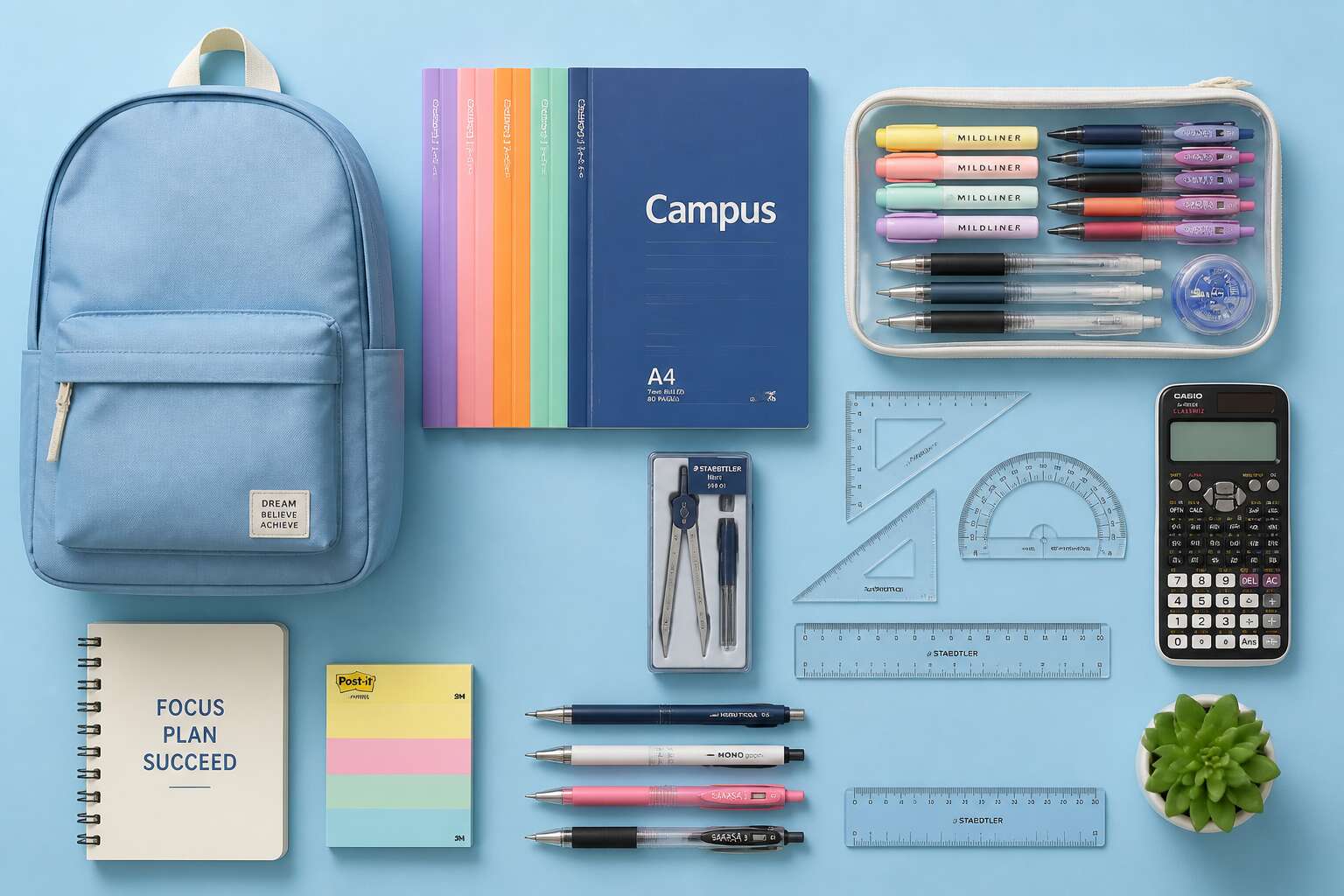
Essential Writing Instruments
Ballpoint vs. Gel vs. Fountain Pens
Selecting the right tools for high school can feel overwhelming, but the choice of pen truly shapes your daily experience. When considering what stationery do i need for secondary school, the writing instrument sits at the top of the list. Ballpoint pens remain the workhorse for most learners; they dry quickly, resist smudging on cheaper paper, and perform well during lengthy exams. I often recommend a smooth 0.7mm or 0.5mm tip for consistent handwriting that doesn’t tire your hand over three hours of writing.
Gel pens offer a different advantage, providing darker, more fluid lines that are pleasant for note-taking and creative subjects. However, they can be slower to dry and might bleed through thin pages. Fountain pens, while requiring more care, teach a steadier hand and reduce writing pressure, but they are a commitment you might postpone to university.
For a practical approach, build a small rotation. Keep a reliable ballpoint as your primary tool, a gel pen for illustrations or diagrams, and a highlighter that doesn’t smudge your work. This mixed system supports fast note-taking and neat presentation without fuss.
– Two blue or black ballpoint pens (0.5mm or 0.7mm)
– One red pen for corrections and marking key points
– A mechanical pencil (0.5mm lead is ideal) for graphs and rough work
Writing for hours demands comfort, so a rubberized grip is a small detail that makes a real difference. Ultimately, the best answer to what stationery do i need for secondary school is a set you can use without thinking, letting you focus on the lesson, not the pen in your hand.
Mechanical Pencils and Standard Wooden Pencils
When you ask what stationery do i need for secondary school, the pencil choice often gets overlooked. Mechanical pencils deliver a sharp, uniform line that never dulls. They excel in maths and technical drawing. Standard wooden pencils, in contrast, offer a tactile and classic feel. They withstand heavy pressure without breaking.
Each type has its quirks. Mechanical pencils require constant refills and careful handling. Wooden pencils need frequent sharpening and produce shavings. A practical approach involves keeping both in your pencil case. Consider the following:
- Use a 0.5mm mechanical pencil for diagrams and precise work.
- Keep a standard HB wooden pencil for general writing and quick notes.
Neither is superior; they serve different purposes. Understanding your own grip strength and note-taking speed will guide your choice.
Erasers, Correction Tape, and Correction Pens
Every student makes mistakes. That is the reality of note taking and exam preparation. Your collection of what stationery do i need for secondary school remains incomplete without a system to erase and correct. A pencil without a reliable eraser is a trap. Graphite smudges, tears paper, and leaves ghosts of previous answers. The solution lies in owning dedicated tools for different surfaces.
Standard rubber erasers handle most pencil work on paper. For detailed maths problems, precision erasers, often shaped like pencils, offer exact removal. However, these rubber blocks are useless against ink. Ballpoint ink resists erasers entirely. This is where correction fluid and tape enter your arsenal. Correction tape applies a dry, clean strip over errors. It allows immediate rewriting. Correction pens, which dispense a liquid film, work better for small, confined spaces. Both tools require a few seconds to dry before you can write over them.
Choose your weapons based on the writing tool they must combat.
- Use a soft, white rubber for graphite and coloured pencils.
- Keep a correction tape dispenser for rapid fixes during lectures.
- Store a correction pen for final drafts and formal assignments.
Cheap erasers often contain abrasive fillers that damage paper fibres. A poor correction job makes your exam paper look messy, which can frustrate a marker. In South African schools, where humidity can affect paper quality, using gentle tools is vital. Invest in quality products. The small cost is nothing compared to the clarity it brings to your written work. Ask any teacher about what stationery do i need for secondary school and they will stress the importance of neat corrections. A clean page allows your knowledge to shine without distractions.
Pencil Sharpeners (Manual and Battery-Operated)
A blunt pencil is a tragedy in waiting. It forces you to press harder, which leads to hand cramps and broken leads at the most critical moment. Untreated, this frustration compounds until a simple geometry problem becomes a personal vendetta. A quality sharpener prevents this downward spiral.
Manual sharpeners with a single blade are fine for emergencies, but they often chew through wood unevenly. Look for a unit with a planetary gear mechanism. It creates a consistent point without snapping the graphite. For high volume users, a battery-operated model is a worthwhile investment. It produces a perfect point in seconds, which is crucial when the teacher is already halfway through dictation.
– Keep a manual sharpener in your pencil case for quick touch ups.
– Reserve a battery operated unit for your desk at home for bulk sharpening sessions.
– Always check the blade quality. Dull blades splinter the wood.
Organization and Note-Taking Gear
Subject-Specific Notebooks and Spiral Binders
The school bag’s interior is where organisational hopes go to die, usually by week two. While one notebook for every subject is a tempting compromise, it is a fast track to chaos. A single book for eight subjects means your History notes on the French Revolution sit next to your Maths theorems, and trust me, Napoleon does not play well with algebra. An 8-subject timetable demands a dedicated system, and this is where the answer to “what stationery do i need for secondary school” becomes less about pens and more about structure.
Spiral binders offer a flexible solution for learners who prefer to rearrange their notes. You can insert handouts, move sections, and tear out pages without the guilt of vandalising a bound book. However, these binders are prone to dents and can be a nuisance in a crowded bag. For a cleaner approach, subject-specific notebooks are the standard. Each ruled notebook, one for English, one for Life Sciences, keeps everything in its place, ready to be filed away after the exams.
Here is a quick breakdown of the binder versus notebook debate:
– A spiral binder is better for subjects with lots of printed worksheets.
– A subject-specific notebook is superior for content-heavy subjects like Biology and History.
– Combining both is possible, but that will add weight to your bag.
Ultimately, the choice depends on how you process information. If you write pages of notes, get the dedicated notebooks. If you compile summaries and past papers, get the binders. The correct answer is the one that stops your bag from becoming a paper cemetery. There is no single rule, only the rule of avoiding total disorganisation. Most learners end up using a hybrid of both, and that is perfectly normal. Your future self, who has to study for the November exams, will thank you for this small act of foresight.
Dividers, Folder Systems, and Document Wallets
A grey abyss waits inside every secondary school bag, and its name is not disorganisation but neglect. A learner can own all the right pens and the most beautiful notebooks, yet still fail the test of retrieval when a teacher asks for last week’s worksheet. This is where the true answer to “what stationery do i need for secondary school” begins to breathe. The solution is a folder system with dedicated dividers for each subject. This simple structure turns chaos into a living archive. It is a quiet ceremony of order that costs little but saves hours of frantic searching.
A simple file folder with eight plastic dividers, one for each period on the timetable, offers the best balance of weight and utility. A sturdy A4 document wallet can also serve as a central hub. These systems keep loose worksheets, tests, and permission slips from dissolving into the bag’s bottomless pit. Consider this basic framework to avoid the crush:
– One plastic folder with eight subject dividers.
– A set of adhesive index tabs for marking the dividers.
– Two clear document sleeves for notices and temporary papers.
The magic happens when this system becomes a daily ritual. Every piece of paper given out, every returned test, must find its home in the correct subject pocket by the end of the school day. This constant curation prevents the dreaded mid-term paper explosion. A single, slimmed-down document wallet for the whole week, emptied every Friday, is another viable rhythm. It is a practice of small, consistent actions. This is the quieter, more profound part of figuring out what stationery do i need for secondary school. The gear itself matters less than the habit it enables, turning a bag from a burial site into a functional tool. Your future self, the one rushing to a Life Sciences revision session, will feel the difference immediately.
Sticky Notes, Page Flags, and Index Cards
Walking into a secondary school classroom with a disorganised bag is a recipe for stress. The question of what stationery do i need for secondary school goes beyond basic pens and pencils. It is about building a system that supports rapid information capture. Sticky notes, page flags, and index cards form the tactical layer of your study arsenal. These small tools allow you to interact with textbooks and notes in a dynamic way, transforming passive reading into active revision.
Sticky notes are ideal for marking key concepts in a textbook or adding reminders to a planner. Page flags offer a more precise method for annotating pages with specific topics, such as marking a page for a history source analysis or a tricky maths formula. Index cards serve as the foundation for a portable revision system. They are compact enough to fit into a pocket for quick review between classes. The true value lies in their flexibility, enabling you to reorganise information as your understanding grows.
To maximise their effectiveness, consider a simple colour-coding method. This approach helps your brain associate colours with subjects or difficulty levels.
- Assign one colour for definitions and new terminology.
- Use a second colour for dates, equations, and formulas.
- Reserve a third colour for questions or areas you need to revisit with a teacher.
This system turns a pile of loose paper into a structured revision tool. When you prepare for a test, you can quickly gather all the relevant flags and cards. The effort answers the question of what stationery do i need for secondary school with a focus on efficiency. This method ensures that your notes are not just a record of a lesson, but an active resource for learning.
Ultimately, the right kit reduces cognitive load. You stop searching for information and start engaging with it. The function of these items is to make the process of studying more tangible. Therefore, when assembling your school bag, give these overlooked essentials the same priority as your exercise books. They provide a simple, effective way to keep on top of a demanding timetable.
A4 Clear Files and Pocket Sleeves
The crumpled mass of loose worksheets at the bottom of a school bag is a universal tragedy. It is the physical manifestation of a student’s chaos. The A4 clear file is the emergency response unit for this disaster. It is a transparent fortress that keeps handed-back tests and printed notes from meeting the fate of crushed sandwiches.
Investing in two or three of these files changes the daily routine. One file should stay at home for completed work that needs safekeeping, while another travels to school for new handouts. The third can serve as a holding pen for permission slips and school notices that need a parent’s signature. This simple rotation prevents the frantic scramble through a bag that eats homework.
For those who prefer a more granular approach, pocket sleeves offer a modular solution. These plastic sheets slip into a binder and hold individual pieces of paper without requiring holes to be punched. This is a lifesaver for teachers who print on thick card or for grammar school notices that refuse to fit a standard punch.
The system works because it reduces the friction of filing. You do not need a hole punch or a lever arch file to maintain order. You simply slide the paper in and move on. This answers the perpetual question of what stationery do i need for secondary school with a solution for managing the paper tide. It also makes finding a specific worksheet for revision a quick task. The goal is to spend time studying, not excavating. A few rand spent on these plastic organisers saves hours of frustration and prevents the dreaded “I lost it” excuse at exam time. Showing up with a clear file full of organised notes is a quiet form of power.
Academic Planners and Assignment Trackers
The average high school student juggles seven subjects, each with its own deadlines, test dates, and project milestones. Relying on memory alone is a recipe for missed assignments and unnecessary panic. A dedicated academic planner acts as an external hard drive for the brain, offloading the cognitive load of remembering every due date. When people ask what stationery do i need for secondary school, the planner is the non-negotiable cornerstone of academic survival. Choose one with a weekly spread that offers ample space for writing down homework for each period. The physical act of writing a task down reinforces its importance far better than typing it into a phone.
For students who struggle with long-term projects, an assignment tracker provides a different layer of defence. It breaks a large task into smaller, manageable steps with individual deadlines.
1. Enter the final due date on the day it is assigned.
2. Work backwards to set mini-deadlines for research, drafting, and editing.
3. Tick off each mini-deadline as it is completed to build momentum.
This system transforms an overwhelming essay into a series of small victories. It turns anxiety into a checklist you can physically conquer. Ultimately, the goal is to reduce the mental noise of a demanding school year, allowing you to focus on learning rather than remembering what you forgot to do.
Measurement, Drawing, and Technical Tools
Rulers, Set Squares, and Geometry Templates
A startlingly high number of secondary school learners arrive for their first technical drawing class without a functioning compass. This oversight often costs them their practical assessment marks. When you consider what stationery do i need for secondary school, precision instruments frequently slip below the radar, yet they are the backbone of subjects like Engineering Graphics and Design. Your basic 30 cm ruler is simply the starting point. Set squares, ideally a 45 degree and a 30/60 degree pair, are non-negotiable for constructing accurate parallel lines. The specific stationery for high school in technical streams often includes a geometry template, which saves minutes when sketching complex ellipses and nuts.
Do not underestimate the value of a quality compass with a locking wheel. A flimsy one will slip mid-circle, ruining your diagram. I recommend purchasing a metal one, as the plastic alternatives tend to snap under pressure during exams. For precise arcs, you will need a protractor, though many learners prefer a combined unit.
– A 45 degree set square
– A 30/60 degree set square
– A geometry template with curves and ellipses
– A friction-locked compass with spare leads
The scale on your ruler matters just as much as its length. A clear, embossed metric scale prevents the eye strain that comes from squinting at printed markings. In South Africa, the metric system is standard, so avoid rulers with inch divisions as they only confuse the reading. Pack these tools securely in a hard case, as a cracked set square is useless for accurate work. This attention to detail is part of the answer to what stationery do i need for secondary school, ensuring your technical drawings are precise, which is a major weight in your final grade. Keep a lead pointer handy, as a blunt compass lead produces thick, messy lines.
Protractors and Compasses for Math and Science
In the realm of angles and arcs, the protractor and compass are the yin and yang of mathematical precision. While a pencil and ruler suffice for simple lines, any serious attempt at geometry or trigonometry demands these dedicated instruments. Assembling the correct what stationery do i need for secondary school list means counting these as non negotiable for your math and science classes.
A standard 180 degree protractor is the workhorse for measuring, but you must inspect its clarity before buying. A frosted or scratched plastic protractor becomes an exercise in frustration when you are trying to verify a 65 degree angle. For science, particularly when plotting data, a protractor helps you interpret pie charts and vectors. Ensure the base is straight and sits flat on your page, avoiding the flimsy versions that invite parallax errors. The materials should be shatter resistant to survive a crowded bag.
Compasses, however, are the true temperamental tools in your arsenal. They can shift a diagram from flawless to laughable in a single revolution. You should look for a stainless steel construction with a reliable control wheel. The adjustment on a cheap compass often loosens mid drawing, altering the distance between the needle and the lead. If you are staring at a bent circle on your graph paper and wondering what to do, the fault might lie in the instrument’s pivot point.
When compiling your specific stationery for high school science, include these two tools alongside your pencil work.
1. A semi static lead compass with a sensitive, grabbing hinge for circles.
2. A lead pointer or a sharpening block to keep the narrow tip consistent.
The proper relationship between the needle and the lead is also crucial. The needle should be slightly longer to anchor the circle, while the lead touches the paper to create a perfect curve. Always test the compass on a scrap piece first before committing to your final answer sheet. That dry run saves you from the heartbreak of a ruined diagram.
Scientific Calculators vs. Basic Models
Measurement and drawing require more than a steady hand. The basic calculator handles addition, subtraction, multiplication, and division. It cannot compute a sine or a square root. For grade 8 onward, a scientific calculator becomes the essential tool for every math and science task.
When considering what stationery do i need for secondary school, the scientific calculator sits near the top. It offers functions like exponents, fractions, and statistical calculations. A basic model will slow you down during tests. You do not want to manually interpolate data.
- Check for a two line display.
- Ensure the buttons have tactile feedback.
- Verify that the battery is replaceable.
The angle mode switch matters too. Degrees versus radians changes everything. Pick a calculator with a durable cover, because a cracked screen ruins the device. Invest once, and it lasts through matric.
Graph Paper, Tracing Paper, and Sketch Pads
So you are staring at the list of subjects for the year ahead, and the question of what stationery do i need for secondary school suddenly feels very real. Beyond the pens and notebooks, the technical subjects demand their own specific toolkit. Maths and Design classes will push you into the world of measurement, where precision is the entire game.
This is where the graph paper comes into its own, providing a grid for tidy statistical charts and complex algebraic graphs. You will also want a sturdy set of geometry instruments. A protractor for angles, a compass for circles, and a set square for perpendicular lines. A pencil with a sharp 2B lead is often better than a pen here, since it allows for subtle shading in technical drawings and easy erasing when a line needs correcting.
For the creative technical subjects, a sketch pad is non-negotiable for rough concept work, while tracing paper proves invaluable for refining a design over a base layout. Keep these tools in a dedicated folder separate from your notes. Getting your hands on the right gear for these classes is a major part of solving the puzzle of what stationery do i need for secondary school, and having the correct rulers will save you from losing marks on sloppy work.
Creative, Highlighting, and Repair Supplies
Highlighters and Gel Markers for Revision
When you wonder what stationery do i need for secondary school, remember that revision demands visual distinction. I often see learners underline entire pages with a single highlighter, which defeats the purpose. Use highlighters sparingly to mark key terms and formulas.
Gel markers offer a different advantage. Their opaque ink works well on dark paper or for annotating printed notes. For effective revision, try this system!
- Yellow for definitions
- Pink for dates and names
- Green for examples
This colour coding helps your brain separate information. I prefer gel markers with fine tips for precise work, and highlighters with chisel tips for broader strokes. Match your approach to your study style, not the other way around.
Colored Pencils, Felt Tips, and Fineliners
The question of what stationery do i need for secondary school often feels like a decoding exercise. Between the mandatory subject lists and the tempting aisle displays, it is easy to end up with a bag full of decorative items that never get used. The secret to surviving high school workload lies in selecting tools that offer both precision and resilience.
Your creative arsenal deserves more attention than the standard blue pen. Colored pencils are essential for biology diagrams and geography mapping, but they also save you when a highlighter is too heavy-handed. Gel pens and felt tips provide the vibrancy needed for titles, while a quality fineliner set offers the precision required for detailed technical drawings.
For a balanced kit, consider these specific creative tools:
– Colored pencils for shading and texture work.
– Felt tip pens for bold, colourful annotations.
– Fineliners for clean, consistent line work in graphs.
A common mistake is relying solely on pens that bleed through thin pages. When you are figuring out what stationery do i need for secondary school, prioritise quality paper and pigment. Remember that correction fluids can smudge artistic work, so using a fineliner with quick-drying ink is a smarter move. After all, a neatly presented assignment often makes a better impression before the teacher even reads the first sentence.
Scissors, Glue Sticks, and Adhesive Tapes
The pressure of a new school year arrives with a familiar question: what stationery do i need for secondary school to actually succeed? While the core items like pens and paper form the foundation of your academic life, the supporting cast of accessories is what transforms a chaotic desk into a hub of productivity. These are the tools that keep your notes intact, your projects cohesive, and your stress levels manageable when deadlines loom. Getting these details right means fewer interruptions during study time and a more polished final result for every assignment.
Beyond the writing instruments, the cutting and sticking arsenal deserves careful selection. A pair of sharp, comfortable scissors is essential for everything from trimming printed notes to executing precise cuts for poster presentations. Glue sticks are the silent heroes of the classroom, binding timelines, diagrams, and revision cards together without the mess of liquid adhesives. For a secondary school student, the difference between a tidy scrapbook and a disaster often comes down to the quality of these basic supplies.
The ability to repair and reorganise is also vital, which is where a supply of adhesive tape comes into play. Whether it is mending a torn textbook cover, affixing a crucial piece of research for a history essay, or quickly mounting a visual aid for a science project, tape offers immediate solutions. For a more flexible approach, washi tape or masking tape allows you to label folders, create colour-coded sections in your planner, and add a touch of personality without damaging the paper.
Here is a concise breakdown of the essential repair and craft supplies that will keep your school year on track:
– Scissors: Choose a pair that feels comfortable in your hand and can handle both paper and card.
– Glue Sticks: Always opt for the larger size; they last longer and apply more evenly.
– Clear Adhesive Tape: Indispensable for quick fixes and mounting work onto displays.
– Double-Sided Tape: This is a game-changer for projects where you need a seamless, clean finish without visible tape edges.
– Mini Stapler: Perfect for keeping multi-page handouts together without causing a jam.
As you compile your list for what stationery do i need for secondary school, do not underestimate the power of a well-equipped supply kit. These finishing touches ensure that when a creative idea strikes for a group project or a teacher hands out a last-minute task, you are prepared to execute it flawlessly, keeping your work looking sharp and professional from the first day of term to the final bell.
Staplers, Staples, and Single Hole Punches
Loose papers accumulate quickly during a school term. When planning what stationery do i need for secondary school, remember the quiet reliability of staplers, staples, and single hole punches. These tools keep assignments intact and revision notes in order.
Each tool serves a distinct purpose:
- A stapler binds multi-page essays and handouts.
- Staples provide the holding force, so choose the right size.
- A single hole punch prepares paper for ring binders or display folders.
Without these basics, a project loses its coherence. A well-placed staple or clean hole punch reflects care, which teachers notice when grading. The outcome depends on such small details.
Carrying, Storage, and Personalization
Pencil Cases, Roll-Up Pouches, and Pen Organizers
I have watched a brand-new pencil case become a shredded mess by the middle of term. That is why carrying matters as much as the pens themselves. Roll-up pouches keep your kit compact and visible. Pen organizers with dedicated slots stop your fineliners from chipping.
Personalization is practical. A bold marker on the inside flap or a unique zip pull cuts down on mix-ups in crowded classrooms.
What stationery do I need for secondary school? The short answer is a storage system that survives. Choose a hard shell for your calculator. Use a soft roll-up for daily pens.
Storage ideas:
- A wire mesh pouch for erasers and sharpeners
- A multi-layer case for subject kits
- A magnetic clip for your desk edge
These options keep your gear organized without taking over your bag!
Durable Backpacks or Messenger Bags
The typical secondary school backpack carries over six kilograms of books, calculators, and loose worksheets. Yet most students choose a bag based on colour, not structure. When asking what stationery do i need for secondary school, the answer begins with how you carry it. A durable backpack with padded shoulder straps and a chest clip distributes weight evenly. A messenger bag forces one side of your body to absorb the entire load, which leads to posture problems by mid year.
Storage matters just as much as the bag’s frame. Look for a dedicated laptop compartment that doubles as a spine for your folder system. A front zip pocket keeps daily pens within reach, while internal mesh sections stop erasers and sharpeners from vanishing. The best setup positions heaviest textbooks against your back, not at the front edge where they strain your shoulders.
Personalization prevents loss. A bold name tag on the inside flap plus a unique zip pull separates your bag from fifty identical ones in the hallway. A simple carabiner or woven patch changes the silhouette, making your gear instantly recognisable. This matters more than you expect, because a lost bag means replacing every item you carefully selected.
Labeling Tags, Name Stickers, and Personalization
Asking what stationery do i need for secondary school often misses how to carry it. A loaded backpack shifts weight with every step, so internal compartments matter more than colour. Keep heavy textbooks nearest your spine, pens in a front pocket, and loose worksheets in a clear sleeve.
Storage needs a second layer. Mesh pouches sort erasers, sticky notes, and page flags. At school, a thin plastic tray in a locker gives each subject a defined space. Separate daily items from refills.
- Pencil pouch for writing tools
- Clear wallet for homework
- Zip pouch for cables
Labeling tags and name stickers prevent loss. Write your child’s name on every notebook and calculator with permanent marker, or buy printed stickers. Attach a plastic tag to the zipper pull with a cable tie. When twenty bags look identical, a glance finds yours. That answers what stationery do i need for secondary school: carry, store, mark.
Emergency Spares (Spare Batteries, Mini Sticky Notes)
The question of what stationery do i need for secondary school rarely includes the humble spare. Yet any parent who has watched a scientific calculator die during a mathematics test knows the value of a backup. Keep two spare batteries taped inside the pencil case, not the bottom of the bag where they get lost.
Storage for these small items needs a dedicated spot. A tiny zip pouch inside the front pocket of the backpack works well. Label the pouch with a permanent marker so it survives the term. The same pouch can hold mini sticky notes for last minute reminders. These small tabs are useful for flagging pages in a shared textbook without damaging the spine.
Personalization extends to these spares. Write the child’s surname on the battery packaging with a ballpoint pen. This simple act answers what stationery do i need for secondary school in a practical way. When the rubber breaks or the lead runs out, the solution is already labelled and within reach. A small service kit saves a trip to the school office and a frantic call home.

0 Comments