
The Grammar of Stationery Explained
Defining Stationery in Modern English
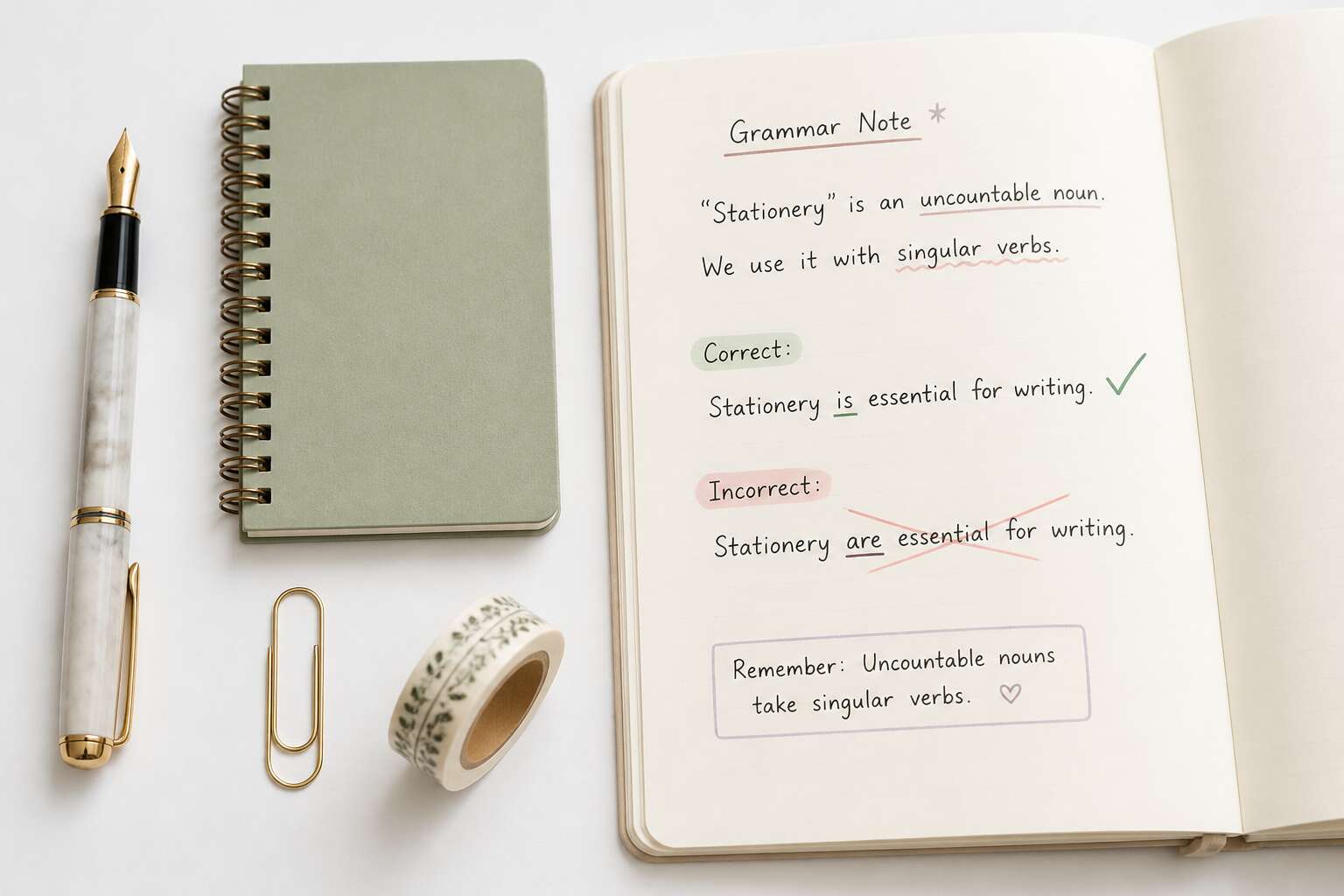
Every inbox at a Johannesburg office contains a request for ‘the stationery.’ The grammar of that request matters. In modern English, stationery is a mass noun, a category word with no distinct plural form. It refers to a collective set of items rather than individual objects.
This explains why people ask whether stationery is singular or plural and then land on different answers! A drawer full of pens and pads suggests a plural meaning. The dictionary disagrees. Stationery takes a singular verb, a singular pronoun, and a singular article.
Consider how the word operates in practice:
- We say ‘the stationery is on the shelf,’ not ‘the stationery are.’
- We say ‘this stationery,’ not ‘these stationeries.’
- We say ‘stationery includes,’ not ‘stationery include.’
The rule holds across every English dialect, including South African usage.
Is Stationery a Countable or Uncountable Noun?
Calling stationery a mass noun feels counterintuitive when you can count every pen in the drawer. Yet English grammar classifies it as uncountable. You do not say “five stationeries.” You say “five stationery items.”
This distinction matters in South African offices where procurement lists blend singular and plural demands. The uncountable classification forces you to add a measure word for precision. That is why the question of whether stationery is singular or plural keeps appearing. The word itself carries no plural marker.
- Equipment stays equipment, never equipments.
- Information stays information, never informations.
- Stationery stays stationery, never stationeries.
Each of these words bundles many objects into one grammatical unit. When you say “stationery is ordered monthly,” the singular verb reflects the category, not the count. The debate over whether stationery is singular or plural ends here: you treat the collection as one thing, even though the drawer holds dozens of distinct objects.
The Role of Stationery in Collective Noun Contexts
Most people feel a quiet tension when they write “stationery is” versus “stationery are.” The word behaves like a collective noun, similar to furniture or luggage. It names a cluster of things while holding them together as a single grammatical unit. This is why the question of stationery is singular or plural keeps recurring in South African offices.
Consider how the noun actually behaves:
– It accepts measure words like “items” or “boxes” when precision matters.
– It rejects plural markers without exception.
– It pairs with singular verbs even when the drawer holds fifty pens.
Procurement language demands a strange mental shift. You treat the category as one entity, yet you count its contents daily. The grammar forces a double awareness. The word never becomes stationeries because the collection is already all there. This is how stationery is singular or plural resolves itself: the category stays whole while the items multiply.
Why Stationery Often Looks Like a Plural Noun
A single drawer can hold thirty pens, yet the word stationery remains stubbornly singular. This visual contradiction explains why stationery is singular or plural confuses so many professionals in Johannesburg and Pretoria. The suffix “ery” suggests a cluster, but English grammar assigns such words a singular verb form. You would never write “the stationery are on the shelf,” even when the shelf holds folders, clips, and rolls of tape.
The plural appearance comes from the noun’s history. Stationery entered the language as a trade term, not a count noun. It names a category, not the items within it. That is why the question of stationery is singular or plural resolves by recognising the word’s internal logic. Each item hides inside the collective, yet the verb points to the single word, not the physical objects.
Understanding the Etymology of Stationery
Tracing the word to its Latin root settles the confusion around stationery is singular or plural. The term comes from “stationarius,” meaning a tradesman who kept a fixed shop. Medieval stationers sold parchment, ink, and bound books to scholars, and by the sixteenth century their wares carried the same name.
Here is where the grammar locks in. Stationery never grew a plural form because it referred to the whole stock of that stationer, not to individual items. The suffix “ery” works the same way in drapery or confectionery; it signals a category, not a count.
- Latin stationarius described the person with the shop
- English transferred that singular logic to the goods themselves
So when a colleague in Johannesburg asks whether stationery is singular or plural, I point to the root, not the drawer of pens. The verb follows the word.
Singular and Plural Forms of Stationery
When to Treat Stationery as Singular
Watch a procurement officer hold a ream of paper and mutter, “our stationery is delayed.” She means the entire stock, not one item. In South African English, this singular treatment emerges whenever stationery represents a category or a bundle. I find that the question of whether stationery is singular or plural disappears when you view it as a mass noun, like “cutlery.” Use the singular verb when describing an amount, a delivery, or a budget line. Consider these moments:
- When tracking inventory: “stationery is stored here.”
- When budgeting: “stationery costs too much.”
- When sending a memo: “stationery has arrived.”
Each phrase treats the entire set as one unit, which is correct for everyday workplace communication. Honestly, that clarity feels good!
Situations Where Stationery Takes a Plural Verb
And yet, the moment your gaze shifts from the stockroom to the desktop, stationery is singular or plural becomes a matter of perception. A single paperclip, a torn envelope, a dried-out marker: each exists independently. When you point at them, the plural verb arrives naturally. “These stationery are mine” still grates, but “the stationery are scattered everywhere” captures a visual truth that the singular form obscures.
Plural verbs emerge whenever the category dissolves into identifiable objects.
- Auditors counting physical items: “the stationery are listed by serial number.”
- Designers arranging sample packs: “the stationery are laid out for inspection.”
- Staff clearing a shared desk: “the stationery are mixed, unsorted, abandoned.”
The verb follows the speaker’s intent. A budget line remains singular. A collection of tangible pieces leans plural, and South African office speech accommodates both without ceremony.
Using Stationery with Quantifiers and Determiners
In South African office speech, “all this stationery” usually points to a heap of loose pens and sticky notes. The determiner changes everything. “Much stationery” treats the category as a single mass, while “many stationery items” splits it into countable pieces.
Consider these phrases side by side:
- All stationery is ordered through procurement (singular).
- These stationery items are labelled by hand (plural).
So when you ask whether stationery is singular or plural, look at the word in front of it. “Some stationery” stays vague, but “three stationery packs” demands a plural verb. That is how a tricky noun stays flexible without breaking grammar.
Regional Variations in British and American English
The question of whether stationery is singular or plural carries a regional accent. British speakers treat “stationery” as a mass noun, so they say “stationery is ordered monthly.” American speakers often do the same, but they also use “stationeries” for multiple branded sets, which sounds jarring to South African ears trained on UK conventions.
- British English: “stationery is” for the whole pile.
- American English: “stationeries” for separate collections.
South African offices blend both influences, yet the singular verb feels safer. When a US client mentions “stationeries,” remember the word shifts meaning. The grammar problem, stationery is singular or plural, reduces to geography. Your local supplier stocks one inventory, so keep the singular. Only when you label ten distinct packs does pluralisation earn its place.
Examples of Stationery in Singular and Plural Sentences
Most office managers never pause to ask whether stationery is singular or plural. They just order the pens and sigh. But when you label items, the grammar shows up. Stationery behaves like one unordered pile. Stationeries appears only when you separate branded sets.
Examples make this obvious:
- Singular: The stationery sits in the drawer, including sticky notes.
- Plural: The two stationeries from different suppliers arrived separately.
In South African offices, the singular verb feels safer. But the plural earns its place with ten distinct packs. The issue of stationery is singular or plural dissolves when you count the boxes.
Common Confusions and Grammar Pitfalls
Stationery vs. Stationary: The Spelling Trap
The spelling trap between stationery and stationary catches experienced writers too. One letter separates writing supplies from something immobile, and spellcheck cannot save you! Most grammar guides dedicate more space to this orthographic hazard than to the debate about stationery is singular or plural.
Consider how the trap deepens. When someone writes “stationary shop,” they mean a shop that does not move. The correct term for a shop selling writing materials is “stationery shop.” I see this error constantly in South African business writing. The confusion bleeds into grammar discussions, because learners often pattern-match the wrong meaning.
Some useful distinctions:
- Stationery always refers to physical writing materials.
- Stationary never refers to objects you can hold.
- Mixing them up creates confusion in any sentence.
Every grammar question about writing materials becomes clearer once this spelling trap is exposed.
Can You Say Stationeries? Unpacking the Rule
Can you say stationeries? The short answer is yes, but with a catch. In everyday South African usage, stationery behaves as a mass noun. You buy stationery, not stationeries. Yet the plural form does surface in older texts and in trade contexts where distinct product lines are discussed. This is where the question of whether stationery is singular or plural gets thorny.
The confusion often starts when people try to apply countable noun rules. A pen is countable. Paper is not. Stationery sits somewhere in between. I have seen job descriptions asking for ‘stationeries’ when they mean ‘stationery items.’ That phrasing signals a grammar pitfall worth avoiding!
Consider these common mistakes:
- Using stationeries when referring to a single bulk order.
- Treating stationery as plural because it ends in y.
- Forgetting that stationery functions like equipment in most sentences.
The deeper issue with stationery is singular or plural usage comes down to context. Formal reports treat it as singular. Trade catalogues listing distinct ranges allow stationeries. Context decides, and that is the real lesson of this debate.
How Collective Nouns Like Stationery Affect Verb Agreement
Even seasoned writers stumble when pairing verbs with stationery. Because the word describes a collection of pens, paper, and other supplies, the instinct to match it with a plural verb is strong. Yet stationery functions as a collective noun, and in South African English it typically takes a singular verb: stationery is, not stationery are. This differs from collectives like committee or staff, which allow plural verbs in British usage. Stationery resists that flexibility, and the question of stationery is singular or plural trips people up accordingly.
Watch for these pitfalls:
– Writing ‘stationery are’ when referring to a store’s inventory.
– Confusing the collective stationery with its individual components.
– Applying distributive agreement, as in ‘stationery are sorted,’ when singular agreement is expected.
I have seen these errors in emails and invoices alike. The question of stationery is singular or plural hinges on recognising its collective nature, so the verb must reflect the whole, not the parts.
Misusing Stationery with Singular Pronouns
One persistent error involves pairing stationery with plural pronouns. People write, “stationery and their prices,” when the correct form is “stationery and its prices.” This mix-up occurs because stationery includes many items, but the noun itself names the whole category, not the individual pieces. The question of stationery is singular or plural becomes clearer when you treat it like water or furniture. Nobody would say “water and their levels” for a single body of water. Stationery works the same way. Common pronoun pitfalls include:
- Using “they” to refer to stationery instead of “it.”
- Writing “these stationery” instead of “this stationery.”
- Matching “stationery” with “those” when “that” is correct.
Each error stems from seeing the parts rather than the collection. Singular pronouns keep the grammar coherent. Remember, the stockroom holds one category, though it holds many objects.
Grammar Checkers and Stationery: Why They Sometimes Fail
Grammar checkers are not, in fact, grammar experts. They are probability machines. Consider how such tools handle the question of stationery is singular or plural. Because they have observed many phrases like “paper and stationery,” they infer that stationery belongs to a plural set. This leads to bizarre suggestions. The programs rarely understand that this noun behaves like furniture, a category that resists plural treatment.
A colleague recently showed me a spellchecker that corrected “this stationery is lovely” to “these stationery are lovely.” The software believed it was helping.
The common failures include:
- False positives on the verb “are” with collective nouns like stationery.
- No recognition of pronoun agreement, so “stationery and its price” goes unflagged.
Clear-Cut Rules to Avoid Embarrassing Mistakes
The quickest way to settle the stationery is singular or plural debate is to compare it with other uncountable nouns. Consider “equipment” or “luggage”. Nobody says “equipments are expensive” or “luggages are lost”. The same logic applies to stationery. It functions as a collective mass noun, not a countable plural.
I have seen embarrassing mistakes in professional emails. A colleague once wrote “Please bring your stationery for the meeting” and then worried whether “your” should be “yours” or if “stationery” needed a plural verb. It does not. The sentence is correct because stationery remains singular even when it refers to many objects.
When in doubt, test with “some”. You say “some stationery” and “some information”, not “a stationery” or “informations”. This habit eliminates most errors!
Practical Guidelines for Using Stationery in Writing
Subject-Verb Agreement with Stationery
Writers often pause mid-sentence, unsure whether stationery is singular or plural. The practical guideline for subject-verb agreement is to treat the word as a singular mass noun when it denotes the general category of writing materials.
You would write “stationery is shipped” rather than “stationery are shipped.” In most professional contexts, consistency matters more than the underlying grammar theory. I have found that reading the sentence aloud exposes most agreement errors. If the verb feels awkward against the singular noun, the solution is to rephrase the subject, perhaps by naming specific items like “pens and paper” which then take a plural verb.
Choosing the Correct Pronoun for Stationery
Choosing the correct pronoun for stationery is the closest thing grammar offers to a trust exercise. Decide whether stationery acts as one unit or many objects, then pick “it” or “they” accordingly. The practical guidelines for using stationery in writing centre on that single decision.
- Use “it” when referring to the general category.
- Use “they” only for specific items like pens or envelopes.
- Rephrase the sentence when neither pronoun feels right.
When you ask whether stationery is singular or plural, you are really asking about your own intent. “The stationery is in the drawer” treats the collection as a singular whole. “The envelopes are in the drawer” treats items individually. Both sentences are correct because the subject differs. That is the whole trick, and it works every time.
Possessive Forms and Prepositional Phrases
Possessive forms often force you to choose whether stationery is singular or plural. “The stationery’s quality” treats the whole collection as one unit, so the verb stays singular. Prepositional phrases work the same way. “The stationery in the drawer” reads as a single mass, while “the envelopes in the drawer” clearly points to separate items.
When you use a prepositional phrase, the noun before the preposition decides the verb, not the objects after it. That is why “the stationery with the torn labels” still takes a singular verb. Here are some practical ways to keep it straight:
- Use the possessive form only when stationery acts as one group.
- Name the individual items in a prepositional phrase if you want a plural verb.
- Read the sentence aloud and ask whether the subject feels like one thing or many.
This approach leaves no room for guesswork. Whether you write “the stationery’s appeal” or “the pens in the tin”, your choice of singular or plural comes from the subject you actually wrote.
Rephrasing to Sidestep Plurality Issues
When the question of stationery is singular or plural slows your writing, rephrase the sentence entirely. Name the specific object instead of wrestling with the collective noun. Say “the letterhead looks crisp” rather than “the stationery looks crisp.” This removes the ambiguity without changing your meaning.
Another tactic is to use a verb that works for both singular and plural subjects. Verbs like “seems” or “appears” behave the same way. I often rewrite a sentence to focus on the action itself. For instance, “the stationery needs sorting” becomes “sorting the stationery takes time.”
- Change the subject to a concrete item.
- Move the action to the front.
- Use a neutral verb form.
These shifts let you sidestep the debate over stationery is singular or plural while keeping your prose clear and natural. Try them next time you feel stuck!
Formal vs. Informal Usage in Professional Writing
In South African boardrooms, the question of stationery is singular or plural often surfaces during email reviews. Formal writing demands precision. When you refer to a company’s entire set of pens, paper, and envelopes, treat stationery as a single unit. Say “the stationery has arrived” to signal a collective whole.
Informal professional writing, such as Slack messages, allows more flexibility. Yet clarity remains key. If you mean individual items, name them. “The stationery is sorted” remains the safer choice, since most style guides favour the singular. Stick to this form in formal documents to avoid ambiguity.
For internal memos, consistency matters more than grammatical perfection. The debate over stationery is singular or plural often disappears when you focus on the specific objects, such as “the letterhead” or “the envelopes.”
0 Comments