
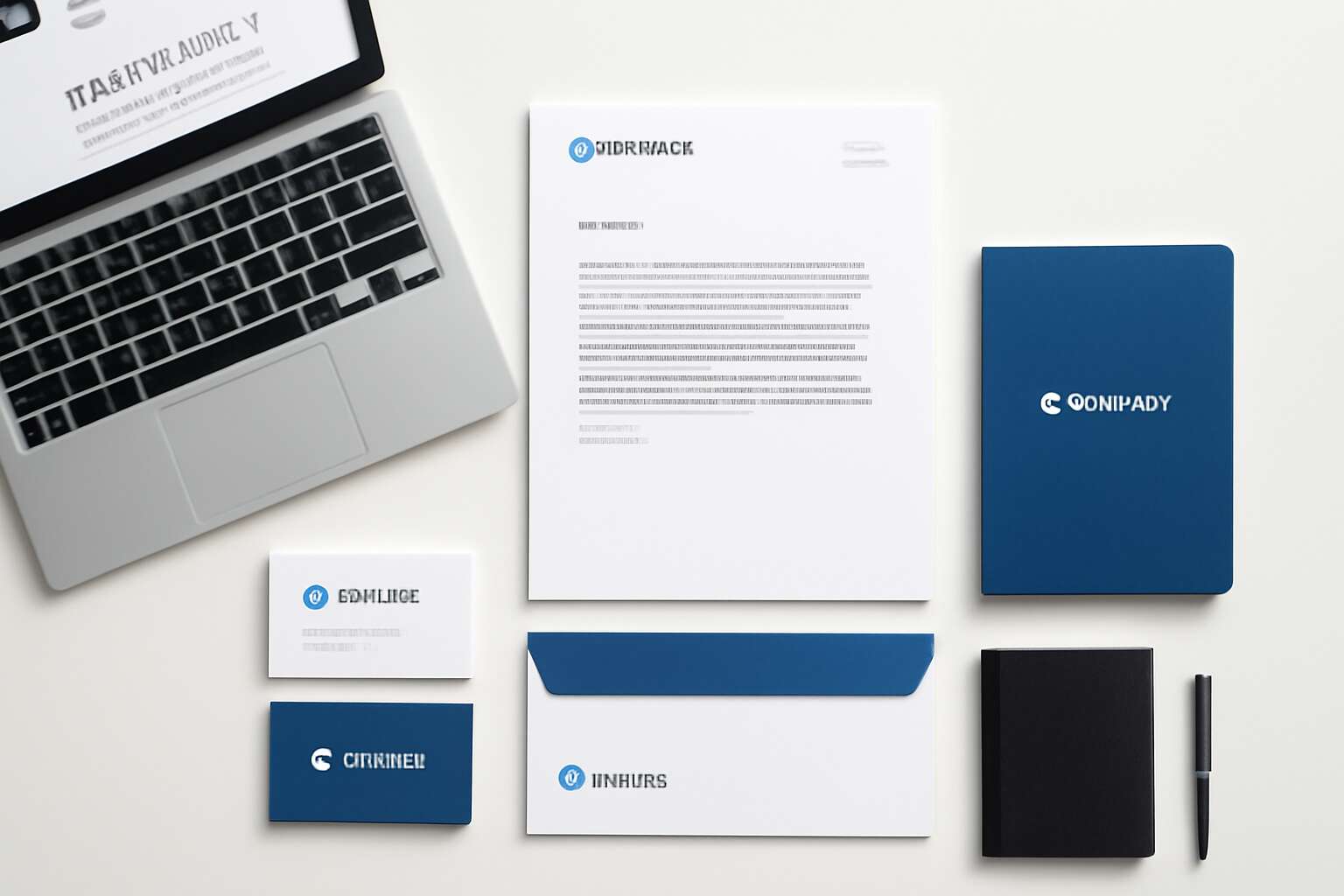
Building a Brand Identity through Corporate Stationery
Aligning logo, typography, and color with brand guidelines
In South Africa’s crowded business landscape, a crisp piece of stationery can speak volumes before a single sentence is spoken. “Brand is the echo of every choice,” a designer once told me—so the ink on your letterhead must carry that resonance and set expectations, instantly. I’ve seen how a simple card can recalibrate a first impression long before the conversation starts.
To build a brand identity through corporate stationery, align the logo, typography, and color with brand guidelines. When these elements sing in harmony, your messages feel deliberate and credible, whether you’re sending a proposal, a memo, or a simple note—the essence of company profile stationery.
Key components guiding this alignment include:
- Logo placement and size
- Typeface family and pairing
- Color system and accessibility
In practice, your brand becomes a quiet ambassador for your identity—consistent, confident, and unmistakably attuned to South Africa’s diverse markets!
Crafting a cohesive tone on letterhead and business cards
In South Africa’s crowded business landscape, first impressions arrive on paper before words are spoken. A striking stat: 78% of decision-makers form an impression the moment they touch a document. That’s why building a brand identity through letterhead and business cards matters—the tone must whisper as loudly as a drum. This is the magic of company profile stationery, a quiet ambassador that travels with every memo!
Crafting a cohesive tone rests on tactile choices—how the surface speaks, how the ink sits, how the envelope arrives.
- Stock weight and texture
- Finish options: matte, satin, or textured
- Envelope treatment and addressing style
Done with care, this stationery suite becomes a mediator between idea and trust. I’ve seen simple cards carry weight, turning a cold proposal into a warm invitation. It’s a gentle promise that the brand is alive—coherent, confident, and unmistakably South African.
Ensuring consistency across envelopes, folders, and digital templates
Across South Africa’s bustling business landscape, first impressions travel on paper before words are spoken. The lever you need is disciplined choice in company profile stationery that keeps your brand voice steady from the envelope to the inbox. Consistency across envelopes, folders, and digital templates isn’t mere detail—it signals trust, attention, and a brand that cares.
From envelope margins to digital templates, alignment feels like social etiquette for brands. I’ve seen a well-ordered suite turn a routine memo into an invitation.
- Envelopes: logo placement and margins aligned
- Folders: color, typography, and embossing consistent
- Digital templates: email signatures, slide decks, and PDFs adhering to the same grid
Done right, this coherence becomes a quiet ambassador that travels with every memo—South African, elegant, and a touch irreverent in the right way. In short, this is the essence of company profile stationery in action across your corporate touchpoints.
Choosing typography for professionalism and readability
Typography is the quiet architect of professionalism in a world where ink outlives the chatter. In South Africa’s markets, the right typeface does more than dress words—it steadies a brand under pressure. When shaping your company profile stationery, think legibility first, then character, so the message travels fast and safely to the reader.
Choose a typographic system that breathes with your brand:
- serif or sans, print and screen harmony
- defined hierarchy: headings, body, captions
- tight yet readable tracking that respects the grid
Applied with discipline, this typography becomes a shadow that follows every memo, making your brand feel timelessly South African—elegant, serious, and a touch haunting. This approach to company profile stationery anchors the brand across every touchpoint.
Establishing a color palette and print contrast rules
Color is the brand’s quiet oath, inked in a language you read with one glance. In South Africa’s markets, the right palette for company profile stationery can establish authority before a word is spoken. A single hue, chosen with restraint, steadies the message amid the noise; a second, used sparingly, gives it rhythm. When I shape identity through color, I lean into mood and contrast, letting the paper carry the story as much as the print. The result is a presence that feels timeless and foretold.
To build that identity visually, establish a color palette and print contrast rules across stock, envelope, and screen. The goal is legibility first, texture second, and character third—so your brand travels across every touchpoint. This cohesion across all company profile stationery ensures a consistent experience, even as lighting shifts and screens glow in South Africa. A framework sits behind the scenes, keeping material cohesive.
Design Essentials for Professional Stationery Sets
Layout grids and white space for letterheads and envelopes
First impressions form in seven seconds, and your letterhead is the handshake. Layout grids and white space guide the eye and sharpen credibility on every page of your company profile stationery. In South Africa’s busy market, clean structure signals reliability and professionalism without shouting!
Key layout choices endorse balance and legibility for letterheads and envelopes:
- Adopt a modular grid to align headers, logos, and contact blocks
- Protect generous white space around the logo and address for legibility
- Set consistent margins to maintain balance on letterheads and envelopes
Discipline with grids yields legible, balanced pages that carry your brand with confidence across print pieces.
Logo placement, margins, and size consistency
That first impression sticks longer than an email thread—seven seconds is enough for credibility to take root, especially in South Africa. Design essentials for professional stationery sets shape that moment with quiet geometry, measured spacing, and a respectful nod to typography, especially when presenting company profile stationery to clients.
Logo placement, margins, and size consistency anchor a calm, trustworthy page. Align the logo with a modular grid, protect breathing room, and keep contact blocks clearly scaled so the page breathes.
- Grid-aligned logo with safe margins
- Consistent typographic scale across all pieces
- Proportional whitespace between blocks
These disciplined choices translate into pages that feel confident, legible, and ready to carry your brand into meetings and mailboxes alike.
Template families for multi-channel correspondence
In seven seconds, credibility plants its roots; in the South African business theatre, that window narrows to a heartbeat. Design Essentials for professional stationery sets emerge as template families for multi-channel correspondence. For a company profile stationery, the voice must echo from letterhead to email header, so the brand becomes a familiar shadow in meetings and mailboxes alike.
Template families keep your presence constant and your tone intact. We guard against misalignment and allow a calm, legible flow.
- Print-centric family: letterhead, envelopes, and business cards that share the same type scale and margins
- Digital-ready family: email signatures, PDFs, and web-friendly headers
- Presentation and proposal family: folders, cover pages, and slide decks with a consistent typographic rhythm
As the pages spread, the stationery becomes a quiet, confident signature—ready to travel from boardroom to mailbox with dignity and ease. That is the mark of company profile stationery in motion!
Visual hierarchy and legibility on small formats like business cards
Across South Africa’s bustling boardrooms, a single card can whisper your intent before a handshake begins! Visual hierarchy acts as the quiet guide, directing attention to the name, role, and means of contact with calm precision.
On small formats, legibility is king. I’ve found that a restrained type scale, bold anchor items, and ample line spacing invite the eye to move with ease; ensure high contrast between type and background, and keep lines short to avoid crowded addresses. The result is a readable card that harmonizes with the broader company profile stationery.
- Establish a compact yet legible type scale that respects print constraints
- Hone contrast so names and contact details pop on digitals and cards
- Preserve a generous safe area to avoid cramping microcopy
Together, these choices ensure that the company profile stationery speaks with one voice—from card to letterhead to inbox—without forcing the reader to search.
Materials, Printing, and Production Best Practices
Paper stock options and finishes
In South African boardrooms, the heft of a well-wrought card speaks louder than emails. Materials for company profile stationery set the tone before a single word is read. Crisp uncoated stock offers clarity; textured linen or cotton exudes gravitas; recycled options satisfy a modern conscience.
- 300–350gsm uncoated stock for clean letterheads
- Textured linen or cotton stock for premium touch
- Recycled or FSC-certified options for sustainability
Printing is where your brand’s voice travels. Offset shines in larger runs; digital handles updates with true-to-brand color management and thorough proofs. Subtle finishes—foil, embossing, or spot UV—add finesse without shouting.
Production best practices fuse precision with presentation. Choose finishes—matte, satin, or soft-touch—and consider edge painting, die-cut shapes, and robust packaging. For company profile stationery, consistent trimming and reliable delivery seal the impression.
Printing methods and branding implications (offset, digital, foil)
“The card is the handshake you can hold,” a mentor once said, and in South Africa’s boardrooms that handshake speaks louder than emails. For your company profile stationery, 300–350gsm uncoated stock gives clean letterheads; textured linen or cotton stock signals gravitas. Recycled or FSC-certified options satisfy a modern conscience, while the right texture quietly anchors your brand in memory.
Printing is where your brand’s voice travels. Offset shines in larger runs; digital handles updates with true-to-brand color management and thorough proofs. Subtle finishes—foil, embossing, or spot UV—add finesse without shouting.
- Offset offers color depth and bulk consistency.
- Digital enables swift updates with color accuracy.
- Foil provides premium accents with a subtle shimmer.
Production best practices fuse precision with presentation. Matte, satin, or soft-touch finishes set the mood; edge painting and die-cut shapes add character, while sturdy packaging seals the professional impression of your company profile stationery.
Color accuracy, proofing, and vendor selection
Materials stage your message before ink meets paper. For standout company profile stationery in South Africa, 300–350gsm uncoated stock keeps letterheads pristine, while textured linen or cotton signals gravitas. Recycled or FSC-certified options reflect a modern conscience, and tactile finishes anchor your brand in memory.
Printing is where color finds its voice. Prioritize color accuracy with well-managed ICC profiles and soft proofs; insist on proofs before production to catch shifts in hue. Choose a vendor whose process aligns with your color standards and can reproduce your brand consistently across runs.
- color accuracy
- proofing
- vendor selection
Production best practices fuse precision with presentation. Matte, satin, or soft-touch finishes set the mood; edge painting and die-cut shapes add character, while sturdy packaging seals the professional impression of your materials—cohesive, memorable, and ready for boardroom engagements.
Sustainability options and eco-friendly packaging
Materials set the tone before ink meets paper. In South Africa, 300–350gsm uncoated stock keeps letterheads pristine, while textured linen or cotton signals gravitas. Recycled or FSC-certified options reflect a modern conscience, and tactile finishes anchor a brand in memory—an instinct I trust.
Printing breathes color into the concept. I lean on color management, ICC profiles, and soft proofs to keep hues faithful; for your company profile stationery, these checks ensure a consistent voice across runs.
Production best practices fuse precision with presentation. Matte, satin, or soft-touch coatings set the mood; edge painting and die-cut shapes add character, while sturdy, eco-conscious packaging seals the professional impression.
- Recycled or responsibly sourced stock
- Water-based inks and coatings
- Biodegradable or compostable packaging
- FSC-certified or PEFC-certified materials
Finishing touches such as embossing or foil accents
Brand memory is minted on the first sheet. In South Africa, a 300–350gsm uncoated stock keeps lines pristine and colors honest, while linen textures whisper gravitas. For your company profile stationery, stock choice sets the tone before ink ever meets paper. Texture, weight, and ethical sourcing mingle to form a quiet handshake with your audience!
Printing breathes color into the concept. I lean on color management, ICC profiles, and soft proofs to keep hues faithful; these checks ensure a consistent voice across runs for your brand.
Production best practices fuse precision with presentation. Matte, satin, or soft-touch coatings set the mood; finishing touches like embossing or foil accents lift the surface into memory. If you want extra personality, consider a subtle deboss or a tailored edge finish that speaks of attention to detail.
Optimization, Accessibility, and ROI of Branded Stationery
SEO-friendly asset naming and digital brand assets for web use
Optimization starts with naming and organizing files—clarity that search engines reward and humans appreciate. For company profile stationery, SEO-friendly asset naming—think descriptor-dimensions and versioning—lets assets index quickly and stay reusable across emails, PDFs, and social previews. Trust me, tidy assets save hours.
- SEO-friendly asset naming conventions
- Web-optimized digital brand assets
- Accessible formats with alt text
Accessibility is not an afterthought; it ensures every digital iteration is usable by all, from tablet readers to screen readers, with strong contrast, readable typography, and tagged PDFs for company profile stationery.
ROI flourishes when branded stationery serves as a web asset: streamlined production, consistent messaging, and higher engagement across channels—turning every template into measurable value for the business and its South African audience.
Accessibility considerations for printed materials (contrast, typography)
First impressions travel on the stroke of ink—one well-crafted sheet can set a tone longer than a meeting. Optimization begins before print: descriptor-dimensions naming and versioning keep your company profile stationery tidy and reusable across PDFs, emails, and social previews. When assets stay consistent, production speeds up and messaging stays clear—turning every template into a durable business asset.
Accessibility isn’t an afterthought, especially for printed materials. Prioritize strong contrast, readable typography, and sturdy margins. For quick reference, consider this checklist:
- High contrast color combinations (minimum 4.5:1 for body text)
- Legible typography with ample leading and clear hierarchy
ROI blooms when branded stationery acts as a web-friendly asset that travels from print to digital. A cohesive package lowers production churn, reinforces brand voice, and resonates with a South African audience across channels. In short, a well-crafted suite of company profile stationery delivers measurable value—every completed template contributing to trust and recognition.
Measuring ROI and impact on credibility and trust
Across South Africa’s markets, a sheet can outlive a dozen meetings. Optimization starts before ink meets paper: descriptor-dimensions naming and versioning keep your company profile stationery tidy and reusable across PDFs, emails, and social previews. When assets stay consistent, production speeds up and messaging stays clear—templates become durable assets.
Accessibility isn’t an afterthought. Prioritize strong contrast, legible typography, and sturdy margins. For quick reference, the checklist below serves as guardrails:
- High-contrast color (minimum 4.5:1)
- Legible type with ample leading
- Adequate margins
- Accessible layouts for small formats
These choices ripple beyond print into digital previews, boosting usability for all audiences.
ROI blooms when branded stationery travels seamlessly from print to digital, reinforcing the company profile stationery across channels. A cohesive package lowers production churn, resonates with a South African audience, and builds credibility and trust that endures.
Supplier evaluation, lead times, and quality control
In a world where one perfect sheet can outpace a hundred emails, optimization starts at the source: a rigorous supplier evaluation, realistic lead times, and a quality control gate. When these steps are in place, print runs feel preordained—fast, predictable, and faithful to brand.
- Transparent SLAs and lead times
- Calibrated proofs and color matching
- Layered quality checks at each stage
Accessibility remains a constant compass, guiding typography choices and layout logic for both cards and digital previews. Accessible design uses reader-friendly fonts, generous spacing, and layouts that scale gracefully across formats, ensuring everyone can engage with the brand from the boardroom to a mobile screen.
ROI blooms when consistency travels across channels; the discipline of optimized sourcing, accessible design, and durable assets builds trust in South Africa’s markets. Investing in company profile stationery pays dividends as coherence across print and digital reinforces credibility and minimizes waste.
0 Comments