POS terminals is a POS terminal supplier establishment in Kempton Park, Gauteng, South Africa
WAPPoint Card Machines & Payment Solutions – Kempton Park
WAPPoint operates as a card machine and payment solutions provider serving businesses in Kempton Park, Gauteng, and across South Africa. The offering centres on modern Android-based payment terminals that combine card acceptance with optional value-added services and point-of-sale capabilities. The emphasis in the service description is on quick connectivity, flexible purchasing options, and a broad suite of apps designed to expand what a card terminal can accomplish beyond simple transactions.
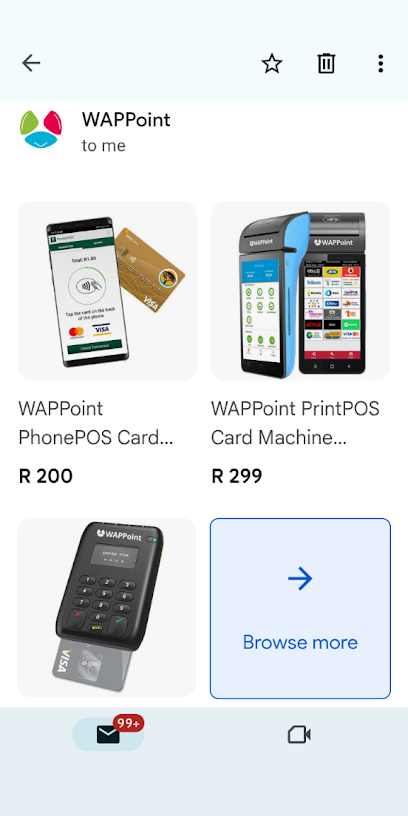
The core product family includes SoftPOS, MiniPOS, PrintPOS, and TabletPOS devices. These terminals are presented as fast, reliable ways to process debit and credit card payments, with several models designed to suit different business sizes and use cases. A notable feature across the portfolio is the ability to procure a free device when turnover thresholds are met, complemented by traditional outright purchase options. The onboarding process is streamlined: customers can initiate online sign-up and receive a card machine with minimal administrative friction, with delivery promised within 1–3 days in many cases.
Beyond basic card processing, the platform positions the devices as versatile business tools. The Android devices support a range of add-on applications (apps) that enable services such as airtime, data, electricity, water bill payments, and other value-added services (VAS). This makes the terminal suitable for retailers, service providers, and hospitality venues that wish to monetise ancillary services directly from the payment device. The company markets a commission model for VAS activities, offering a structured set of earnable incentives across airtime, data, electricity, water, bill payments, and money transfers.
Customer experience is highlighted through several service pillars. The dedicated support proposition avoids call-centre fatigue by offering a hand-picked care team intended to provide a “VIP” level of assistance. Remote technical support is advertised as a core capability, with the ability to resolve issues by logging in remotely, which can minimise downtime during busy trading periods. Flexible engagement options also include rent, free devices tied to turnover milestones, or outright purchase, allowing businesses to scale their payment capabilities in line with growth and cash flow considerations.
The value-added software options extend the functionality of the devices. A basic Lite POS is available for simple sales tracking, client capture, and inventory reminders, while a more comprehensive POS solution supports Windows, cloud, or app-based deployments. The POS functionality is designed to integrate with inventory management, loyalty programmes, hospitality operations, and accounting tools such as Xero, making it suitable for multi-branch operations or venues with evolving needs.
Practical terms are outlined in the materials: 24–72 hour connectivity for new setups, a commitment to PCI DSS compliance, and the ability to switch between device types as a business grows. The pricing and packages are presented with transparency, including monthly rentals and SIM costs, and a promise to match or beat competing rate offers. Additional assurances include a 30-day money-back option and the convenience of settling transactions to any bank account, with easy bank account changes if needed.
Typical client profiles described in the materials include retailers and service-oriented businesses that require reliable mobile or table-mounted payment solutions, as well as venues requiring integrated POS capabilities. The offerings also reference support for events and other short-term needs, with rapid deployment designed to accommodate both long-term operations and temporary setups.
Practical tips for customers
- Assess turnover thresholds to determine whether a free device option is available and align procurement with expected monthly sales to maximise value.
- Consider the VAS add-ons to monetise ancillary services like airtime, data, or utility payments directly from the device, but review commission structures to understand earnings potential.
- Evaluate whether a Lite POS suffices for basic operations or if a comprehensive POS (Windows, Cloud, or App-based) better supports multi-site management and accounting integrations.
- Leverage remote technical support to minimise downtime; ensure an onboarding path that includes easy activation and rapid delivery, particularly for high-demand periods or events.
- Confirm flexibility in payment settlements by verifying bank account compatibility and the ease of changing settlement accounts if necessary.
WAPPoint also communicates a commitment to security and reliability, noting PCI DSS compliance as a foundational attribute. The company positions itself as a partner in business growth, emphasising ongoing support, onboarding efficiency, and a service ethos that extends beyond mere transaction processing.
Kempton Park
Gauteng
South Africa
Sorry, no records were found. Please adjust your search criteria and try again.
Sorry, unable to load the Maps API.
POS Terminal Supplier Services in Kempton Park, Gauteng
In Kempton Park, Gauteng, businesses seeking point-of-sale (POS) terminal solutions can expect a range of services designed to support cash register efficiency, payment speed, and customer experience. Suppliers in this region typically cater to small independents, mid-sized retailers, restaurants, and service providers, offering equipment, software, installation, and ongoing support. The aim is to provide reliable devices that handle common payment methods, integrate with existing business workflows, and deliver secure transaction processing.
Core services usually begin with guidance on choosing suitable hardware. This encompasses a selection of PET- and Android-based terminals, countertop models, portable devices for mobile or queue-free service, and receipt printing options. Many providers emphasise durability in South Africa’s varied trading environments, with devices designed for busy shops, markets, and hospitality venues. The emphasis is on devices that remain operable in light of power interruptions, with attention to battery life, charging logistics, and the feasibility of back-up options when connectivity is interrupted.
Alongside hardware, POS terminal suppliers typically offer software integration support. This covers configuring the payment software to work with existing inventory, sales, and reporting systems, as well as enabling standard functions such as sales processing, refunds, splits, and daily close‑outs. While specific platforms may vary, the general expectation is for compatibility with common industry standards and secure handling of cardholder data. Suppliers may provide guidance on selecting software packages or compatible peripherals, such as barcode scanners, cash drawers, and receipt printers, to create a cohesive point-of-sale environment.
Installation and onboarding are presented as practical stages rather than mere transactions. Initial site assessment helps determine the most suitable terminal types and network connectivity—whether wired Ethernet, Wi‑Fi, or mobile data. Installation often includes mounting or placement advice, configuration of taxes and local currency settings, and linking devices to a central management system for monitoring and updates. Training may be offered to staff, focusing on daily operation, transaction types, and basic troubleshooting. Clear documentation and user guides support ongoing use beyond the initial setup.
Security and compliance form a central consideration in Kempton Park and across South Africa. POS terminal suppliers typically address encryption of card data, PCI-DSS basic practices, and compliance with local payment regulations. They may also provide information on firmware updates, device hardening, and procedures for handling lost or stolen devices. As a practical matter, customers are encouraged to understand role-based access, regular reconciliation, and secure handling of physical devices, particularly in busy retail or hospitality settings.
Maintenance and after-sales support are expected as part of a comprehensive service. This can include remote diagnostics, scheduled maintenance, and replacement of faulty components. Most suppliers offer ongoing technical assistance during business hours, with escalation paths for more complex issues. Depending on the service level agreement, customers might benefit from guaranteed response times, field technician visits, or 24/7 support for critical failures. Inventory management features, software updates, and compatible accessory stock may be kept as part of a maintenance package to reduce downtime and ensure smooth operations.
- Hardware procurement: a range of durable, payment-ready terminals and peripherals suitable for busy environments.
- Software configuration: alignment with sales, inventory, and reporting systems and secure payment processing basics.
- Installation and onboarding: site assessment, connectivity setup, and staff training.
- Security and compliance: data protection practices, updates, and best-practice procedures.
- Maintenance and support: remote and on-site assistance, with defined service levels.
For businesses in Kempton Park, considerations extend beyond device capability to reliability, local support, and total cost of ownership. Evaluations often weigh the ease of integration with existing systems, the availability of spare parts, and the ability to scale as the operation grows. With the right supplier, a retailer or hospitality venue can secure a POS solution that delivers efficient transaction processing, clear reporting, and practical backup options for the South African trading environment.